The National Digital Strategy Action Plan for 2026–27 ('Action Plan') forms the core of Portugal’s digital transformation agenda for the next two years.
For Portuguese companies, the 2026 27 Action Plan marks a significant advancement in digital requirements concerning relations with the state, data management, legal compliance, and information security.
The year 2026 thus marks the beginning of a new era in which digitisation is no longer an optional internal project for organisations, but an essential commitment. There is no room for inertia; otherwise, your organisation risks becoming irrelevant in the market.
This Action Plan clearly demonstrates that a sense of urgency in the race towards digital transformation is crucial for achieving competitiveness and strategic advantage in the market.
Legal reference: Resolution 214/2025[1] (the “Resolution”), which approved the National Digital Strategy Action Plan for 2026–27.
What is the government’s plan for 2026-2027
In a rapidly developing regulatory and technological context, the sense of urgency is greater than ever. The digital transition is no longer optional, but essential for competitiveness and access to support, strategic partnerships, European funding, and the relationship with the state itself.
The Resolution aims to accelerate the implementation of the 2030 targets and establish Portugal as one of the European Union’s (EU) top 10 most digitally advanced countries.
The Action Plan sets out targets to be implemented through concrete actions that will impact public and private organisations. The Action Plan focuses particularly on data, interoperability, artificial intelligence (AI) and cybersecurity.
It is clear that this legislation requires a swift response from public and private organisations alike, urging them to accelerate their digital transition to avoid losing competitiveness and access to support.
Impact of the Action Plan by type of organisation:
Companies

Public services
Infrastructure
People (digital skills)

The plan’s actions that directly impact each type of organisation
To anticipate obligations and access funding opportunities, training programmes and new forms of interaction with the Public Administration, organisations must pay constant attention to these actions.
In order to maintain or strengthen their competitiveness in the market, companies should closely monitor the implementation of the Action Plan and its biannual updates. They should also invest in digital skills, cybersecurity and data governance, positioning themselves to take advantage of new platforms and support programmes.
The Action Plan is structured around 20 areas of intervention or actions, detailed in projects with defined deadlines, descriptions of activities, and details of the entities responsible and involved.
(See the glossary section below for the definitions of the 20 actions set out in the plan)
Highlights include the following actions:
A more digital, integrated and secure Public Administration (Actions 1 a 4):
- The Common ICT Architecture (Action 1) will centralise data centres, streamline networks, migrate to the cloud, and establish common interoperability and security standards. The new Agency for Technological Reform of the State (ARTE) will lead this.
- Focus on a collaborative hub and public procurement of innovation, bringing together the state, companies, and R&D centres. Innovative companies will have more opportunities to test solutions.
- Implementation of concrete plans for incident prevention, detection and response, including characterising public systems and creating technical and financial support mechanisms for critical incidents. Suppliers will face significant regulatory and contractual pressure to ensure high levels of cybersecurity, service continuity and incident reporting.
Legislation, interoperability and data (Actions 5 to 9 and 16)
- Creation of a digital ready legislation guide and integration of digital assessment into the legislative process itself, including the use of artificial intelligence tools such as SmartLegis.
- Creation of a code of conduct for the use of AI in the legal sector, addressing the requirements of interoperability, security, and ethical use of AI, as well as the use of advanced analytical and procedural management tools.
- Creation of a legal instrument that makes the use of the iAP platform mandatory, ensuring the circulation of data and taking responsibility for the quality, consistency, and security of the information provided.
- Development and approval of the implementing instrument for the Data Act[2], and revision of the implementing instrument for the Data Governance Regulation[3].
- Definition of an integrated data strategy, a national sovereign classification model, a review of record bases, the implementation of the Data Act and the strengthening of applications such as 'My Data in Public Administration'. For companies, especially those operating with sensitive data or critical infrastructure, this will mean clearer and more stringent regulations regarding where and how data can be stored, how it is classified, and how it interacts with European data spaces.
- Simplification and harmonisation of the national regulatory framework will align it with key European initiatives, such as the Digital Omnibus, which aim to foster a more favourable environment for innovation, competitiveness, and investment in the digital economy.
Digital public services and relations with citizens and businesses (Actions 10 to 12)
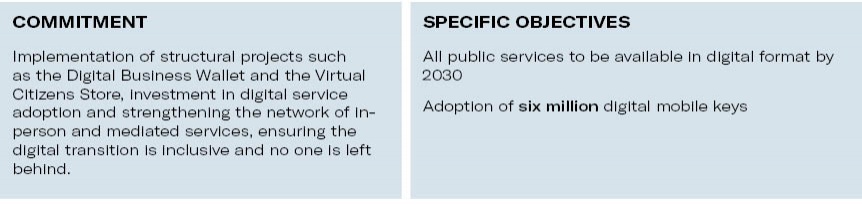
- It is expected that all services will be digital by 2030, based on gov.pt digital channels. These channels will serve as a single point of access - an omnichannel with a mobile first approach. Strategic products are being launched, including the Digital Business Wallet, the Digital Building Wallet, the ‘LicencIA’ licensing platform, integrated ticketing with citizen cards and the Virtual Citizens Store.
- The public consultation process and interaction between the State and citizens will be centralised through the development of Participa.gov 2.0.
Digital infrastructure, sovereign cloud and emerging technology (Action 13)
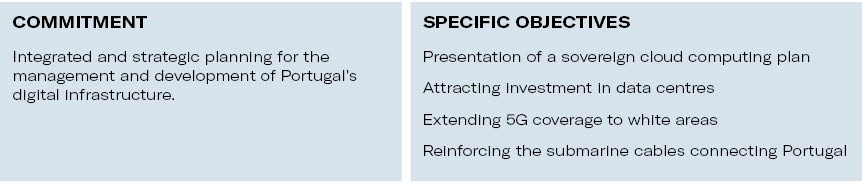
- Establishment of a detailed strategic plan for developing and implementing a sovereign cloud infrastructure to enhance the capacity of national cloud service providers, ensuring security, data control, and compliance with European standards. The sovereign cloud will be essential for regulated sectors and sensitive data. This will require cloud and SaaS providers to review their hosting, encryption and data governance models in order to comply with national requirements. Meanwhile, the National Data Centre Plan and the expansion of computing capacity for AI will create opportunities for new businesses in data centres, industrial AI, research, and data-based B2B services.
Support for digital transformation and business innovation (Actions 14, 15 and 20)
- Allocation of ‘Coaching 4.0’ vouchers as part of the National Digital Executive Training Programme, alongside specific measures for digital commerce and internationalisation via e commerce. Companies that act quickly will bve able to access financing, consultancy services, team training and support for entering new digital markets, provided they demonstrate growing digital maturity.
- Support for digital innovation and entrepreneurship will be provided, with funds dedicated to emerging technologies, IFIC lines for AI, cloud, defence and security, and programmes for the internationalisation of the startup and scaleup ecosystem will be strengthened. Tech startups and innovative SMEs will have increased opportunities for high TRL funding, access to testbeds, technology-free zones and international networks, provided they can demonstrate scalability, security and alignment with public priorities.
- Implementation of the National Artificial Intelligence Agenda to ensure the coordinated implementation of over 30 planned initiatives for 2026–2027.
Digital skills (Actions 17 to 19)
- The integrated implementation of actions set out in the National Programme for Girls in STEM, with the aim of empowering and including women in science, engineering, mathematics, and information and communication technologies.
- Accelerating the digital transformation of the education system.
Glossary of the action in the 2026-2027 Digital Strategy Action Plan
- Action 1 - Definition of the Common Architecture for Information and Communication Technologies in Public Administration
- Action 2 - Development of the Agency for Technological Reform of the State, I. P.
- Action 3 - Digital innovation ecosystem in Public Administration
- Action 4 - National Cybersecurity Strategy
- Action 5 - Digital-ready legislation
- Action 6 - Digital and AI in Justice
- Action 7 - New Interoperability Regime
- Action 8 - National Data Policy
- Action 9 - PAGE - State Management Support Platform
- Action 10 - Digital Public Services of the Future
- Action 11 - Integrated Vision for Omnichannel Service
- Action 12 - New forms of civic participation
- Action 13 - Strategic review of the National Digital Infrastructure
- Action 14 - Support for the Digital Transformation of Businesses
- Action 15 - Support for Digital Innovation and Entrepreneurship
- Action 16 - Simple, clear and pro-innovation digital regulation
- Action 17 - Digital Skills Pact
- Action 18 - National Programme for Girls in STEM
- Action 19 - Digital and AI in Education
- Action 20 - National Artificial Intelligence Agenda