More tax incentives and new rules for beneficiaries
On 18 August 2026, Decree-Law 167/2026of 17 August 2026 came into force, amending the rules on patronage set out in the Tax Benefits Statute (EBF).
The most significant changes relate to cultural patronage. Donors now enjoy greater tax benefits, but the organisations and projects receiving the donations are subject to stricter rules regarding recognition, registration and monitoring. These rules are set out in Ministerial Order 437-A/2026/1 of 25 Septemberand are administered by the Office for Cultural Strategy, Planning and Evaluation (GEPAC).
1. Key changes
The reform has three main ideas:
- Clarifying what constitutes a donation and how its value is calculated.
- Increasing the limit up to which companies can deduct donations to 1% of turnover or the value of services provided, and increasing the enhanced deduction rates for cultural patronage.
- Introducing a system for the prior approval, public registration and monitoring of beneficiary organisations and projects. Any amounts not used for the purposes that justified the tax relief must be paid into the Cultural Promotion Fund.
2. Tax treatment of donations
In addition to the transfer of assets, it is now clear that a donation in kind includes the temporary secondment of employees and the provision of services free of charge as part of the donor’s normal business activities. This rule applies to all patronage schemes and is particularly relevant to corporate volunteering.
This is important because a donation only entitles the donor to a tax benefit if it is made without any commercial or financial consideration in return. The law now clearly states that certain benefits received in return are acceptable and will not affect the tax benefit. These are: (i) gifts to the donor, provided their value does not exceed 5% of the donations made during the year, and (ii) the institutional promotion of the donor’s name or logo, provided this is not advertising-related, does not reference brands, products or services, and explicitly mentions the donor’s patronage status. In practice, organisations may acknowledge their donors and publicise their support. However, if the support functions as advertising or sponsorship, it is no longer treated as a donation, meaning the donor loses the tax benefit.
The value of the donation taken into account depends on the type of support:
- Assets: the cost of acquisition or production, minus depreciation and other value adjustments accepted for tax purposes.
- Secondment of staff: the costs relating to the remuneration and social security contributions of seconded staff during their period of secondment.
- Free services: the normal market value of such services, calculated in accordance with VAT rules.
The deduction limit rises from 0.8% to 1% of turnover from sales or services provided. The overall limit on deductible donations under the social, scientific and cultural patronage schemes is also 1% of turnover. Donations to public bodies remain outside this limit.
For cultural patronage, each euro donated generally counts as €1.40 of expenditure, reflecting an enhanced deduction equal to 40% of the donation’s value. This may rise to 50% if the donation arises from a multi-year contract with defined objectives and amounts.
Donations are not taxed for the recipient, but the expenditure they finance is also not deductible up to the same amount.
Donations to companies with which the donor has a close relationship (for example, companies in the same group) do not qualify for tax relief. Similarly, donations made by founders to private-sector-only foundations are generally not eligible for tax relief.
3. Beneficiaries and cultural status
The new rules change who is eligible to receive donations under the cultural patronage scheme, introducing two new statuses: ‘cultural organisation’ and ‘cultural initiative’.
The following are now eligible to benefit from cultural patronage:
- Organisations dedicated exclusively or predominantly to cultural activities, including non-profit organisations and public enterprises.
- Public or private non-profit organisations holding the status of ‘cultural organisation’.
- Individuals and organisations, whether public or private, that promote initiatives or projects with the ‘cultural initiative’ status.
The status of ‘cultural organisation’ is valid for five years and may be applied for by:
- Organisations that own or are responsible for cultural facilities, such as theatres, museums, libraries and historical and documentary archives.
- Cultural co-operatives, institutes, foundations and associations dedicated to preserving tangible and intangible historical and cultural heritage.
- Cultural centres organised in accordance with the statutes of INATEL (National Institute for the Enjoyment of Leisure Time).
In all cases, the primary focus of the organisation must be cultural activity, and the organisation must have adequate resources, financial stability and sound management.
’Cultural initiative’ status is intended for projects in areas such as performing arts, cinema, literature, heritage, museums, fashion, design and video games. In exceptional cases, it may also apply to projects of significant public interest in other areas.
Project organisers must demonstrate the project’s viability, open a dedicated bank account and maintain basic records of income, expenditure and assets. Individual organisers must also be registered as carrying on an activity in the cultural sector and maintain organised accounts.
Assets acquired with this funding may only be used for the cultural purposes of the project, and cannot be sold or used for any other purpose without authorisation from the government.
4. Platform and registration
The National Patronage Platform on the gov.pt website will centralise applications, documents, notifications, certificates and reports.
All beneficiary organisations must be registered on the platform and registration is automatic for organisations granted the relevant status. Organisations must report any relevant changes within 15 working days. Failure to do so will result in suspension of their registration.
The list of beneficiary organisations is public and published on the Tax Authority website (Portal das Finanças). This allows patrons to confirm eligibility before making a donation.
5. Application and recognition
Designations as a ‘cultural organisation’ or a ‘cultural initiative’ are granted by the government minister responsible for culture, after GEPAC has issued its opinion. The duration of ‘cultural initiative’ status is set in this order.
Applications must be accompanied by documents relating to the organisation or project, including a description of the activity, a plan and a budget and, in the case of entities, the accounts for the previous three years.
A simplified procedure applies to organisations that have received public funding for cultural activities in the last three years.
6. Summary: limits, enhanced deductions and deadlines
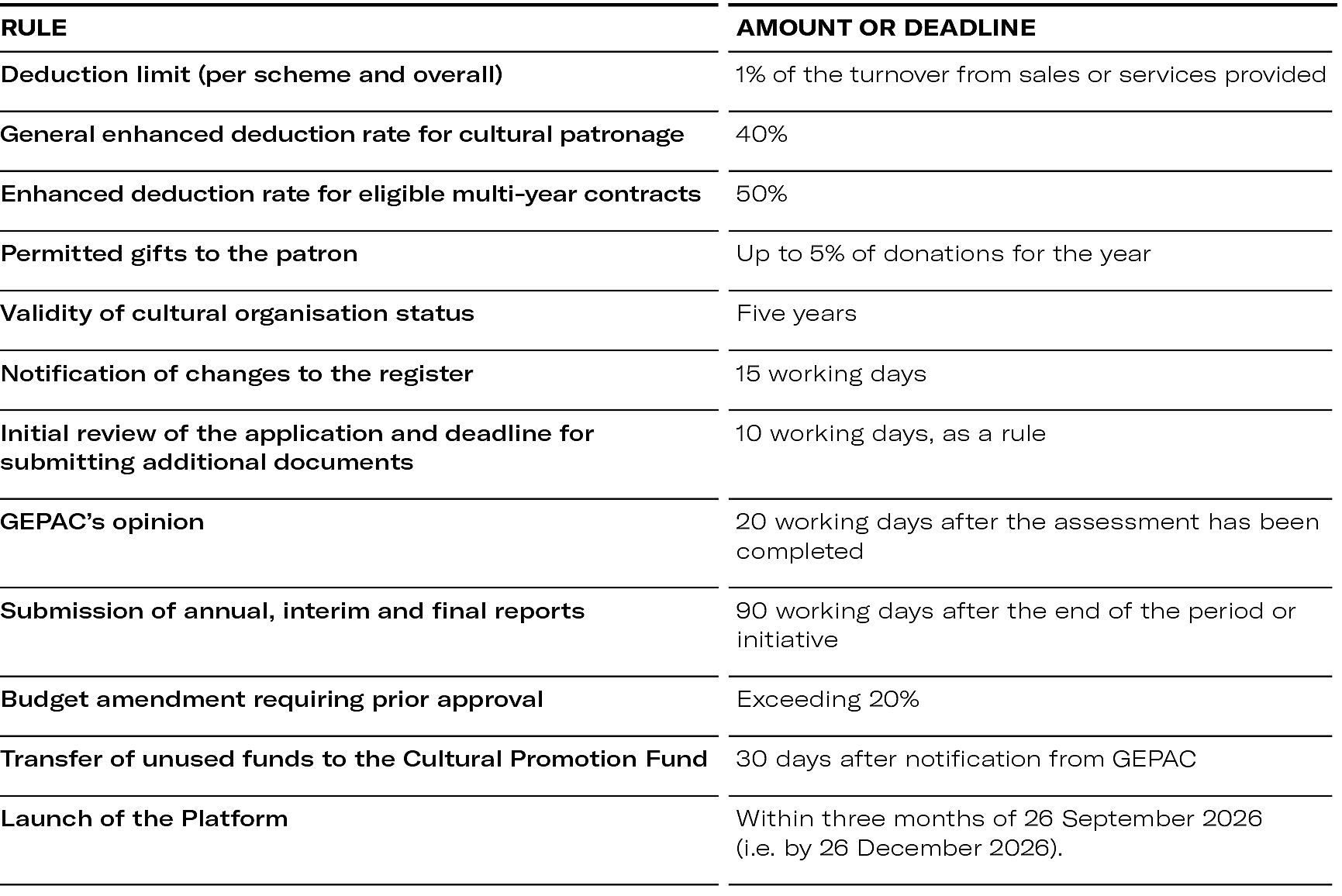
Renewal of cultural organisation status is not automatic and must be applied for between 180 and 90 working days before the expiry date.
Until the platform is operational, applications should be submitted to GEPAC via the electronic channel specified by GEPAC.
7. Monitoring and loss of cultural status
Cultural organisation or cultural initiative status will be withdrawn if the eligibility criteria are no longer met or if the beneficiary has outstanding tax or social security debts.
Each year, beneficiaries must confirm that they still meet the eligibility criteria and seek prior authorisation for significant project changes, such as delays exceeding six months or budget changes of more than 20%. They must also submit annual reports and a final report at the end of each initiative.
Any unused project funds must be returned to the Cultural Promotion Fund within 30 days of notification by GEPAC.